Enabling the impossible with the BBC’s Synthetic Weather Forecast.
I led the discovery and design of one of the BBC’s most ambitious synthetic media projects: a spoken weather forecast for every postcode region in Britain, updated four times a day, every day.
The project grew out of the BBC’s in-house synthetic voice, “beeb”, originally created in 2019 for the BBC’s experimental voice assistant.
Unlike Alexa or Siri, the BBC deliberately avoided the familiar trope of the submissive female assistant voice. “Beeb” sounded distinctly northern, helping challenge assumptions around both gender and regional bias in voice technology.
But when the beeb assistant was discontinued in 2021, the synthetic voice was left without a clear purpose.
The technology found occasional uses across the organisation. It narrated articles on bbc.co.uk, and producers at BBC Radio 4 and the BBC World Service even used it to create on-air trailers:
But these applications often felt more like novelty than meaningful innovation.
That changed in 2022, when we identified an opportunity at a scale that simply wouldn’t have been possible using traditional production methods: dynamically generating localised spoken weather forecasts for the whole of Britain.
Spotting the opportunity
The BBC News skill on Amazon Echo was already the UK’s most popular voice news experience. Originally launched in 2020 and nominated for a Webby Award, the skill allowed listeners to move through news stories like tracks in a playlist and dive deeper into stories they cared about.
I joined the team in late 2021 to lead product design. One of the first features we introduced allowed users to connect their BBC account, enabling personalised local news updates from their nearest BBC radio station.
Six months later, I facilitated an ideation workshop exploring what smart screen devices could unlock for the experience.
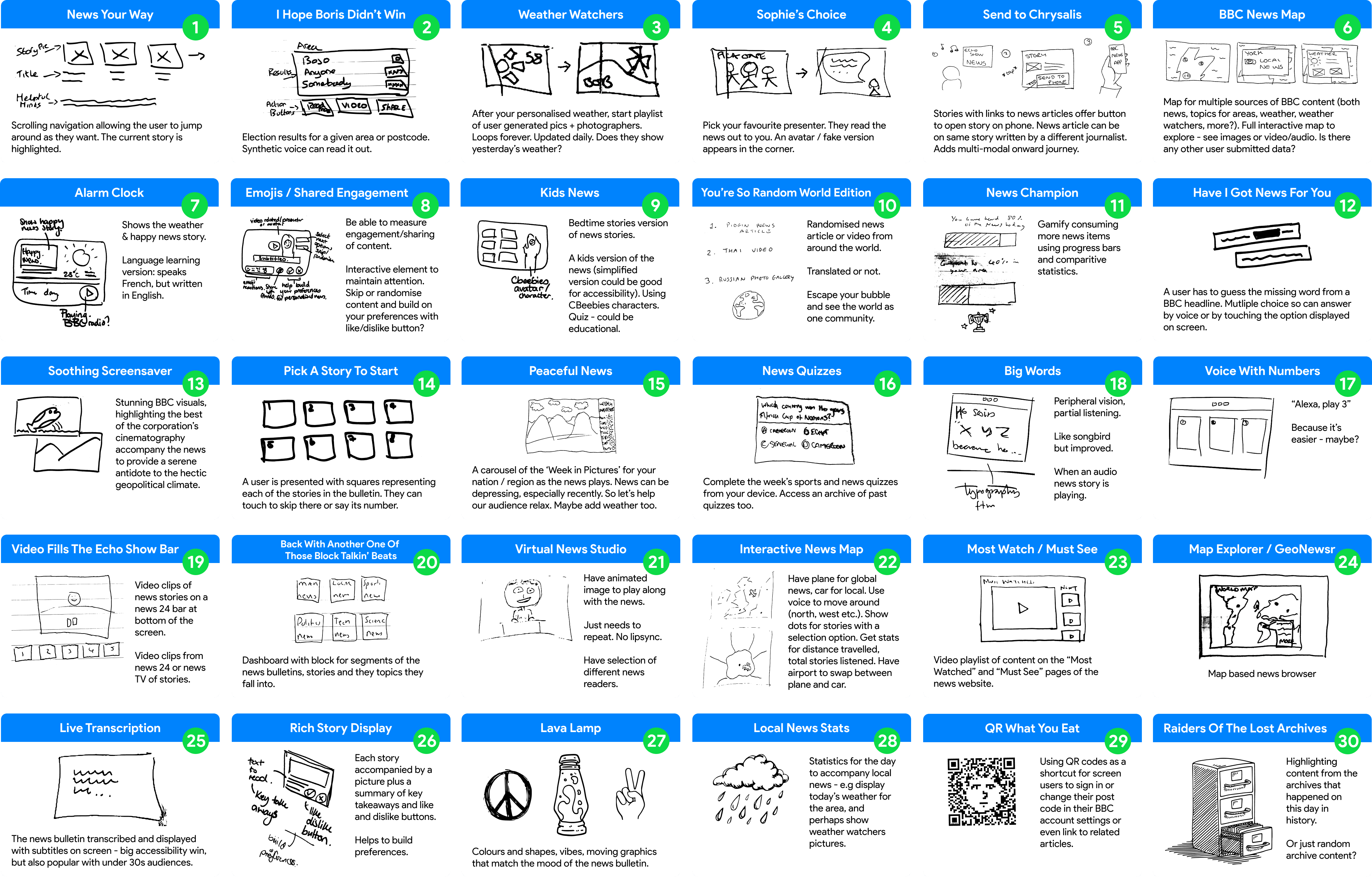
The workshop generated dozens of ideas, followed by a hack week where I led the design and prototyping of three concepts for user testing.
One prototype displayed personalised imagery from BBC Weather Watchers based on the user’s postcode.
We tested each of the concepts with users and although reactions to the crude visuals of our weather prototype were mixed, it was clear that users cared deeply about weather.
Defining success
I began pursuing the weather idea by researching how people used weather forecasting on smart speakers. Even by 2021, asking for the weather forecast remained the third most common smart speaker use case in the UK.
I then analysed the leading competitor: Amazon Echo’s built-in weather experience.

The experience exposed five clear weaknesses:
- Forecasts covered areas that were too broad.
- They lacked meteorological detail.
- The delivery felt flat and robotic.
- They didn’t come from a trusted weather authority.
- Users had to explicitly ask for the weather.
Together, these gaps revealed a significant opportunity.
We could create a dynamically generated spoken forecast using the BBC’s synthetic voice, integrate it directly into the BBC News bulletin, and outperform Amazon’s experience across every one of those dimensions.
Trust and reduced friction
The BBC already held a major advantage: trust.
BBC Weather carried far greater authority with UK audiences than Amazon’s weather partner, AccuWeather, and the BBC’s own synthetic voice felt considerably more human than Alexa’s default delivery.
There was also an opportunity to reduce friction.
Instead of requiring users to separately ask for the weather, we could seamlessly combine local weather with the national and regional news bulletin millions of people were already listening to every day.

The remaining challenges (localisation, depth, and richness) were harder problems to solve, but the opportunity was compelling enough that the team agreed to pursue the idea as an experiment.
A more focused forecast
To make the forecast genuinely useful, we decided to generate weather reports for every postcode region in Britain.
Postcode regions break the UK’s 1.8 million postcodes into roughly 3,000 manageable geographic areas. They were specific enough to provide meaningful local accuracy, while still being practical to generate at scale.
Engineering quickly began building a pipeline on top of the BBC Weather API.
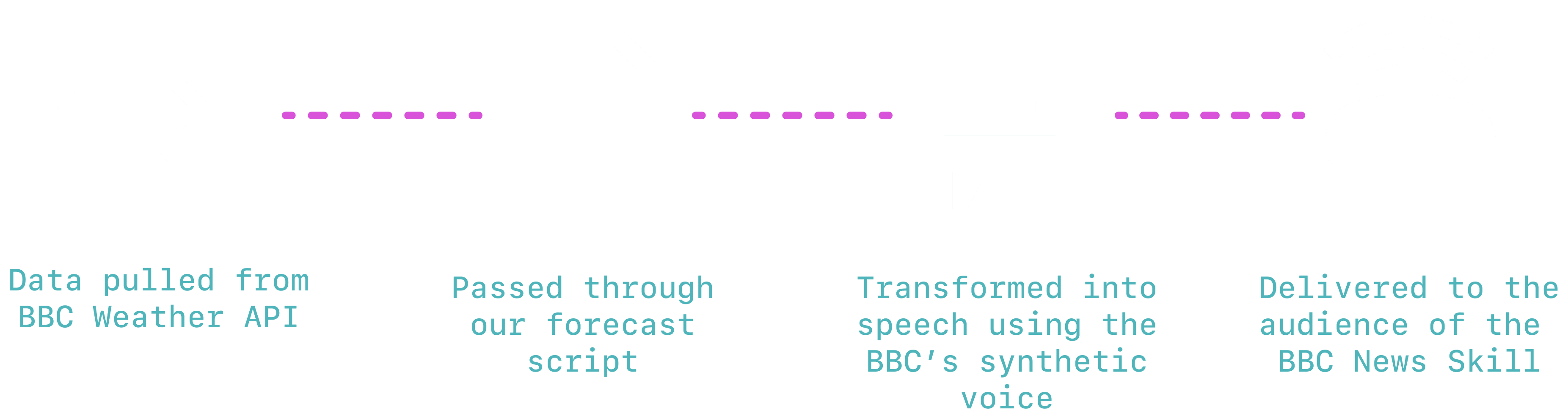
A user’s postcode region was retrieved from their BBC account, passed into the weather system, converted into forecast text, and then transformed into speech using the synthetic voice.
With careful optimisation, the system was able to batch-generate forecasts for all 3,000 postcode regions in just 12 minutes.
Each forecast lasted around 45 seconds, and infrastructure costs came in far lower than expected, making it viable to refresh forecasts multiple times a day.
Meteorological depth
Next, I needed to define the structure, timing, and conversational logic behind the forecasts.
I divided the day into four forecast windows, each made up of five core sections:
- current conditions
- highs and lows
- wind
- exceptional weather phenomena (such as UV, pollen count, humidity)
- what to expect later in the day
Using data from the BBC Weather API, I mapped the forecasting logic into a large, time-based matrix that visualised how the experience would adapt across changing conditions and times of day.
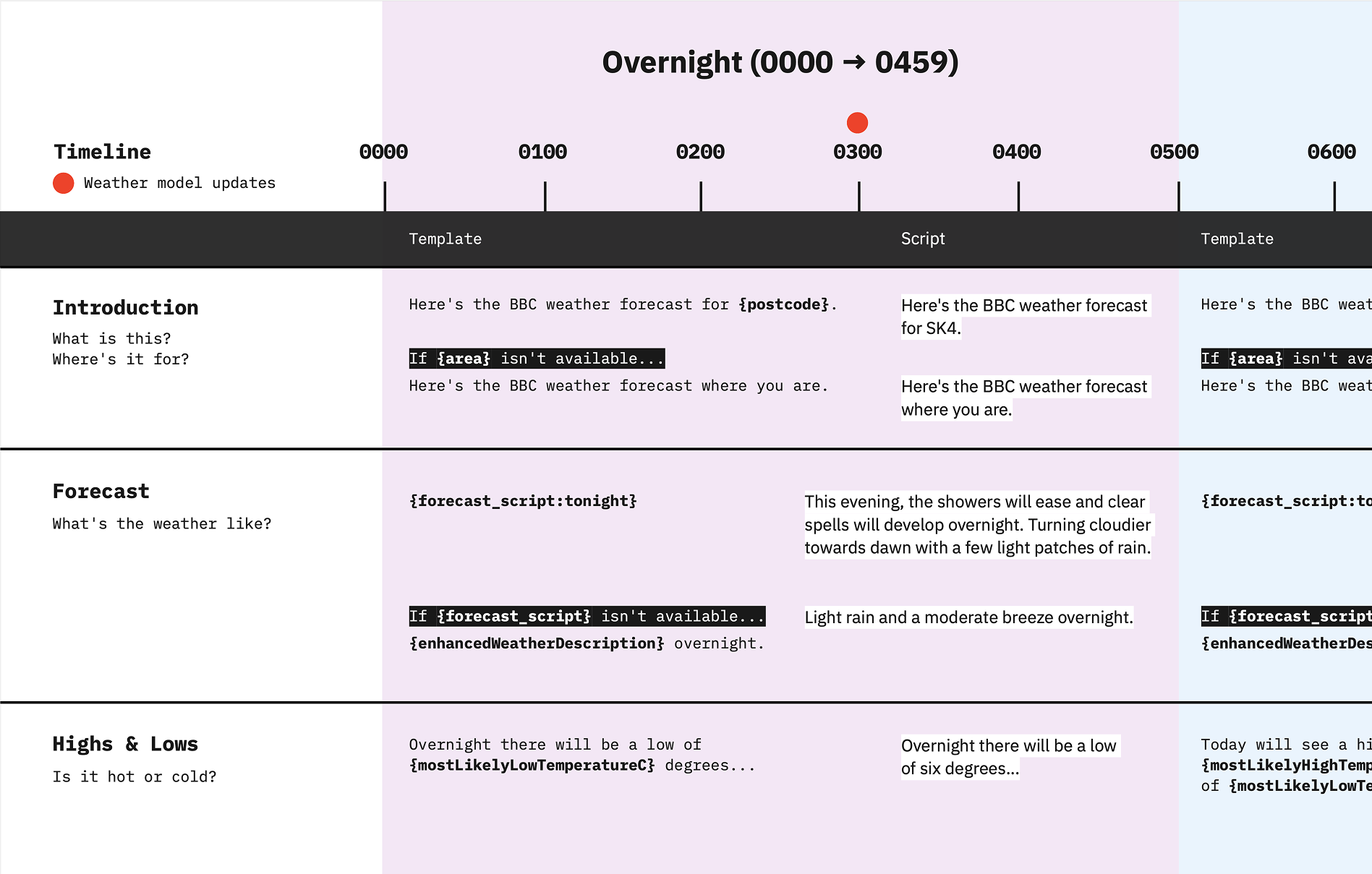
The matrix became a critical cross-functional tool. By laying the entire conversational flow across a 24-hour timeline, it made complex scripting logic significantly easier to design, sense-check, and iterate on.
Meteorologists used it to validate that forecasts felt natural and meteorologically accurate, while engineers used it as the blueprint for the forecast generation pipeline itself.
Bringing conversational structure, forecast logic, edge cases, and editorial rules into a single visual system helped align design, engineering, meteorology, and editorial teams around a shared understanding of the experience.
The end result was a far richer and more nuanced forecast than Amazon’s equivalent, delivering significantly greater meteorological depth.
A rich audio experience?
But there was still a major problem.
Although the BBC synthetic voice sounded convincing in isolation, its limitations became obvious when placed immediately after a human-read local news bulletin.
Without natural variation in tone or inflection, the forecast felt flat and artificial:
For an organisation known for world-class audio, that simply wasn’t good enough.
Retraining or redesigning the synthetic voice itself would have been prohibitively expensive, so I explored another option: using sound design to reshape the listening experience.
Initially, I experimented with background music alongside a design trainee. While music helped mask the synthetic quality of the voice, it introduced unintended emotional tone.
A rainy forecast suddenly sounded melodramatic. More neutral ambient music made the experience feel oddly spa-like.
Instead, we took inspiration from the immersive “weather ambience” visuals BBC Weather had recently introduced across its digital products — animated scenes of rain, snow, and condensation viewed through virtual windows.
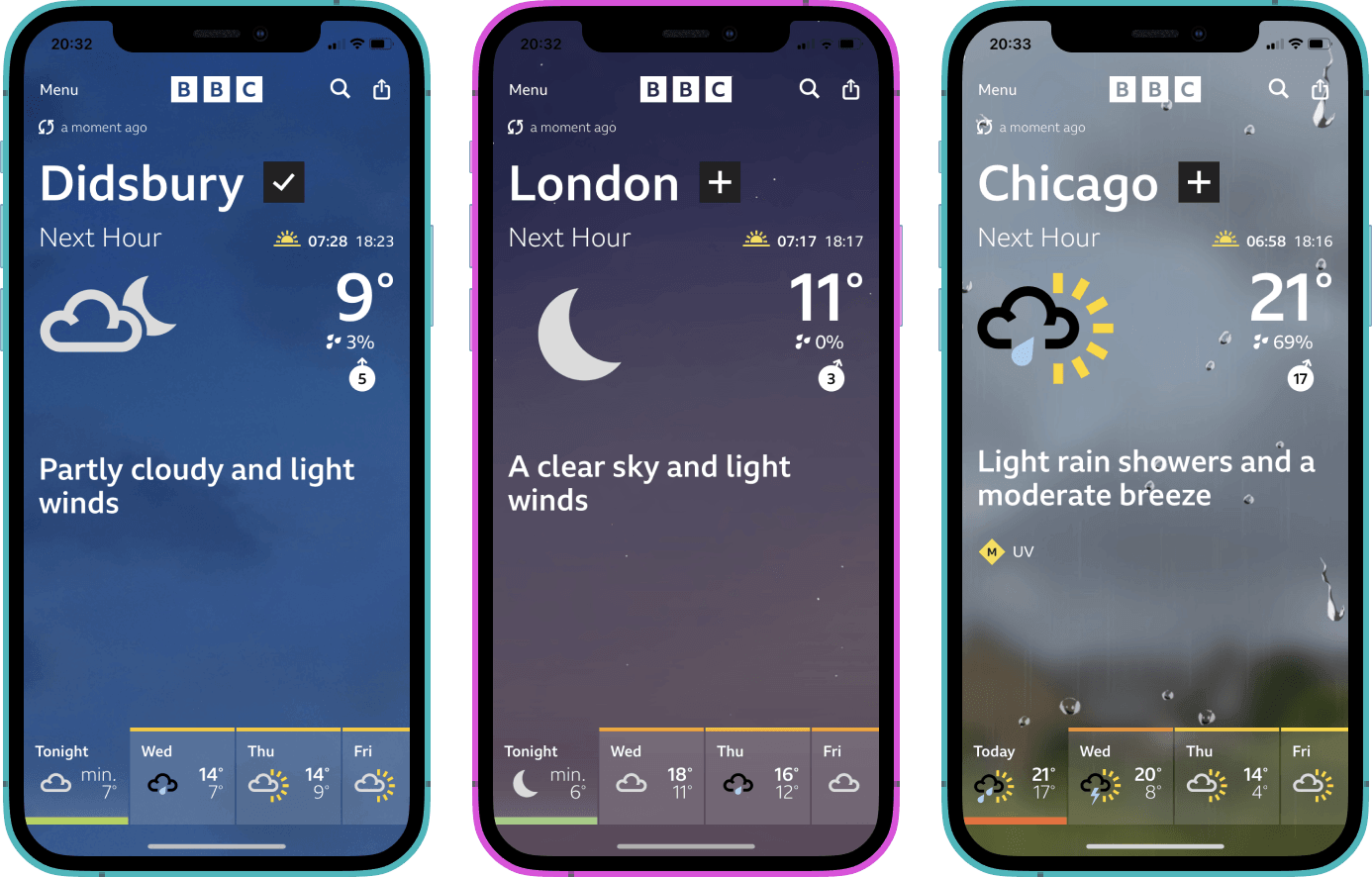
We translated that idea into audio using atmospheric recordings from the BBC Sound Effects archive.
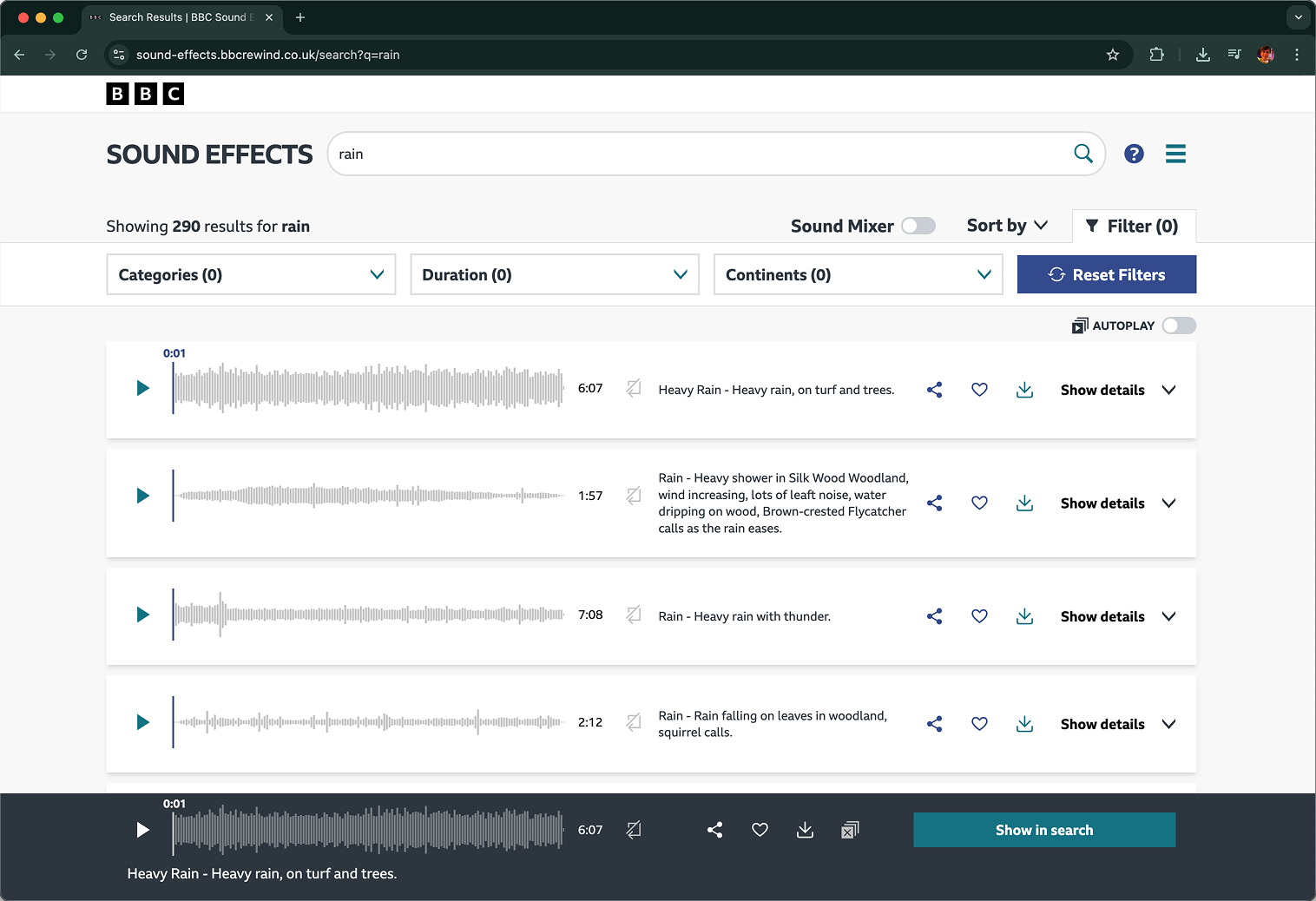
This approach transformed the experience.
Rather than competing with the voice emotionally, the sound effects created atmosphere and texture, making the forecast feel more immediate and cinematic. Almost as though the weather was happening just outside the listener’s home.
We layered and blended effects to create soundscapes for every conceivable condition, from thunderstorms to blizzards, and engineered them to loop seamlessly across forecasts of varying lengths.
The finished article
Each forecast begins with two seconds of atmospheric weather audio before the ambience subtly fades beneath the spoken forecast.
In total, we created 17 distinct weather soundscapes covering everything from clear summer evenings to sandstorms.
The result felt dramatically richer than Alexa’s equivalent and helped smooth over the remaining limitations of the synthetic voice.
There was also an unexpected benefit: because many of the recordings originated from the BBC’s own radio production archive, the experience inherited a subtle but unmistakably “BBC” character.
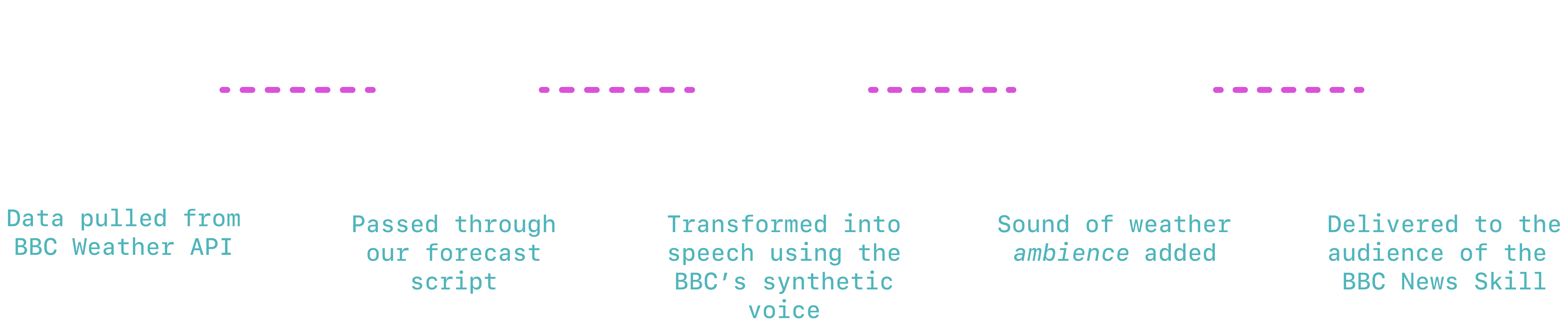
Engineering then extended the pipeline to dynamically apply the appropriate ambience to each forecast, and in October 2022 we launched the experiment.
The scale of the solution
The completed system generates 40 second forecasts for all 3,000 postcode regions, four times each day.
That means that each day, our pipeline produces more than 133 hours of original audio.
The daily operating cost of this service is just £160.
Compared to the cost of content production elsewhere in the BBC this provides incredible value for money.
Outcomes
The initial experiment achieved a forecast completion rate of 96%.
That figure was especially significant because the BBC News skill was intentionally designed to encourage skipping between stories – something users frequently did during standard news content.
But when listeners hear a hyper-local weather forecast for their own postcode region, they stick around.
The experiment also reached 86% of Britain’s postcode regions, demonstrating both the technical reach and broad audience appeal of the experience.
BBC Director-General Tim Davie highlighted the work as an example of two major strategic priorities coming together successfully: hyper-personalisation and generating greater value from digital services.
In Conclusion
This project demonstrated how synthetic media could be used responsibly and meaningfully to create experiences that would otherwise be impossible to produce.
By combining automation, localisation, editorial thinking, and sound design, we transformed structured weather data into a rich, scalable, highly personalised audio experience.
What began as an experimental use for an orphaned synthetic voice ultimately became a fully launched BBC product, rolling out to general availability in early 2023.
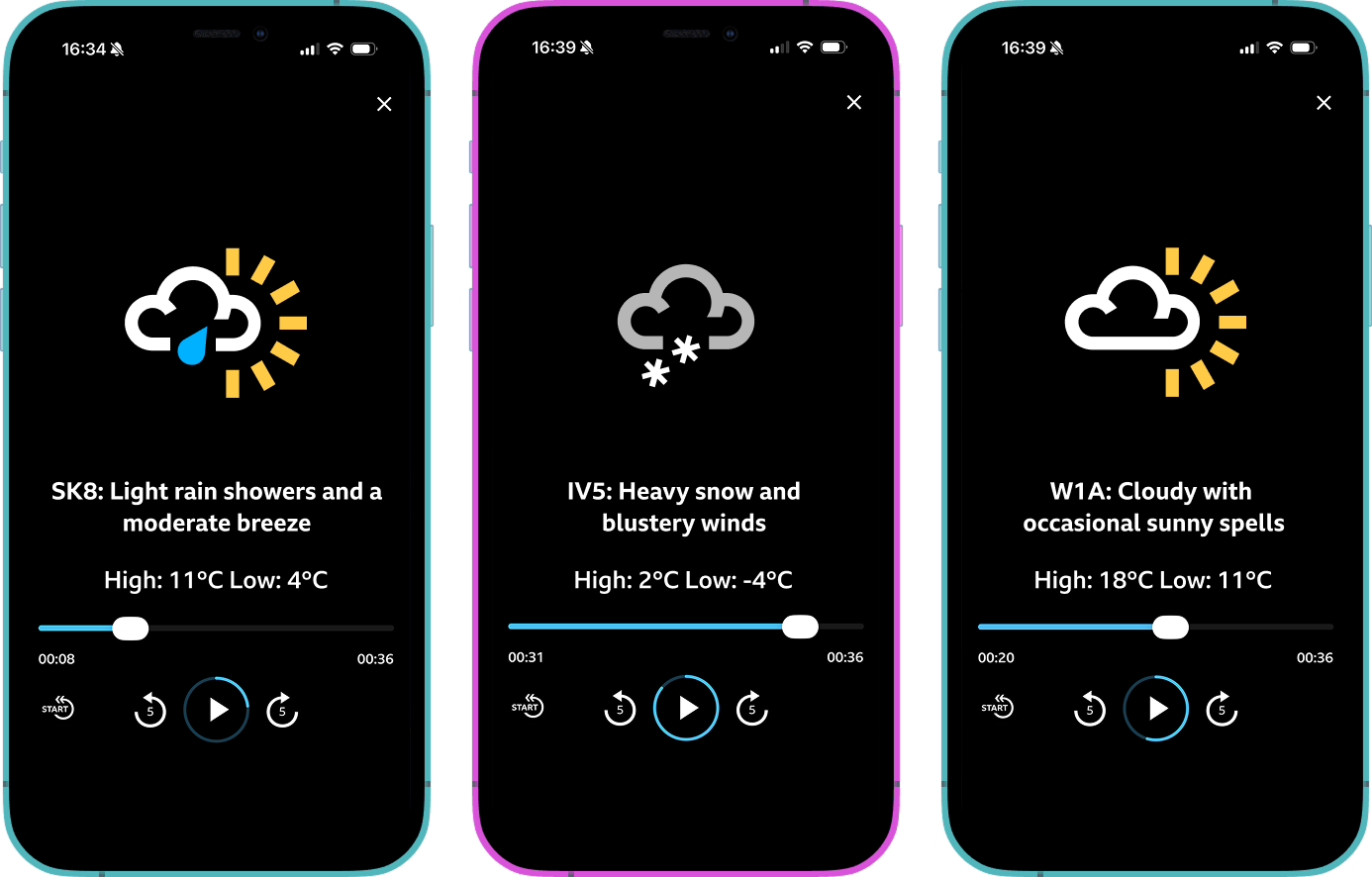
The success of the voice experience also led to the forecasts being integrated into the BBC Weather app itself, extending the work beyond smart speakers and into one of the BBC’s most widely used digital products.
You can still hear the experience today by asking Alexa for BBC News or through the BBC Weather app's “Listen to the forecast” feature.