Designing a voice experience for an audience still learning to speak.
I led the design of the multi award-winning BBC Kids Skill, bringing together teams from across the BBC to create the world’s most successful voice experience for preschoolers.
Unlike most Alexa skills, which focus on a single interaction, the BBC Kids Skill combined games, stories, songs, and educational experiences into one cohesive product designed specifically for children.
But creating a voice experience for an audience still learning to speak presented an entirely new set of design challenges.
Understanding through research
I joined the BBC’s Voice + AI team in February 2017 to lead the design of the BBC Kids Skill alongside Product Manager Lisa Vigar and Senior Producer Simon Cobb.
Very little guidance existed for designing voice interfaces for children at the time. Whilst the BBC Children’s team had extensive knowledge of how children interacted with digital products, we had little understanding of how those behaviours would translate to smart speakers and conversational interfaces.
Working closely with Design Researcher Charlotte Davies, we established an ambitious research programme, running user testing sessions with children every three weeks throughout design and development.
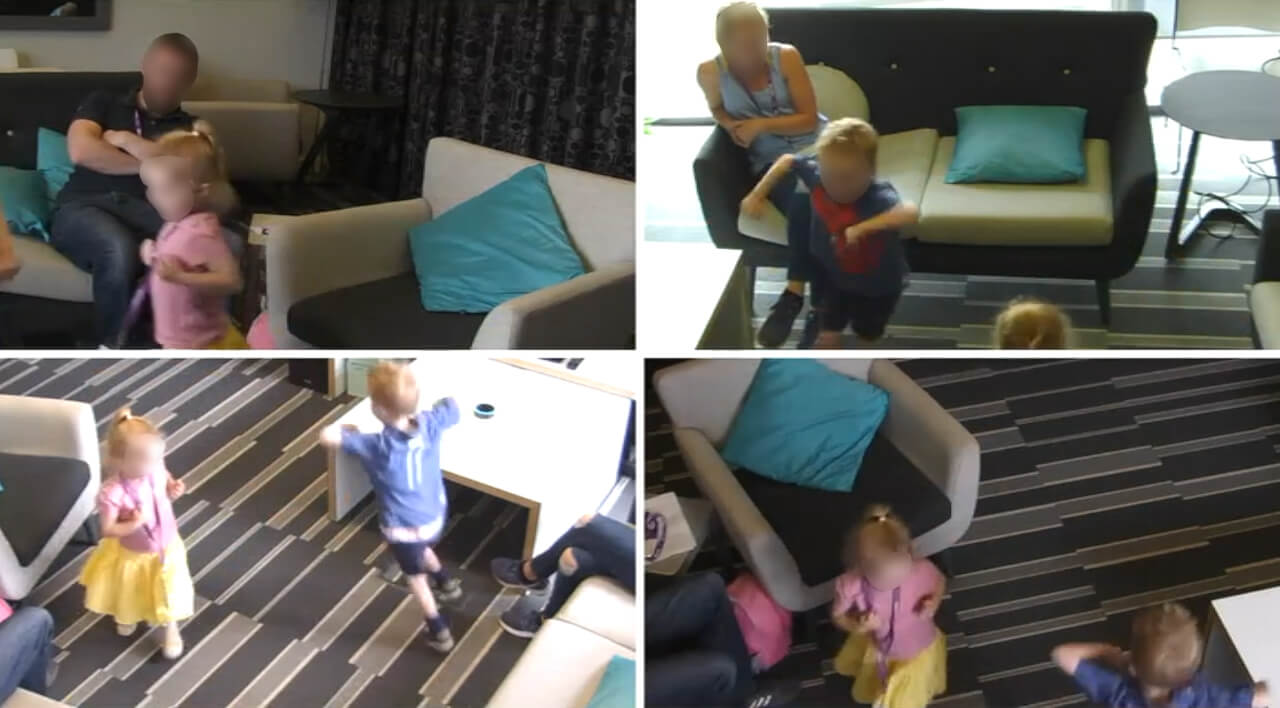
Three consistent patterns quickly emerged:
- Children are inarticulate — they have limited vocabularies and often pronounce words inconsistently.
- Children are hypersensitive — they become frustrated or upset very quickly.
- Children are inattentive — they are impulsive and easily distracted.
These behaviours repeatedly caused traditional voice interaction patterns to fail.
In response, I guided the team toward simpler conversational flows, forgiving interaction patterns, and more emotionally supportive responses that reduced friction and frustration for children.
Over time, these research sessions showed measurable improvements in engagement, completion rates, and enjoyment.
A unique design process
Designing for voice required us to rethink traditional UX methods almost entirely.
I led the team through an exploratory and highly collaborative design process as we figured out, in real time, what designing for voice should look like.
One of the biggest challenges was communicating conversational logic across very different audiences.
For engineers, I created highly detailed conversational flow diagrams in OmniGraffle that mapped branching logic, error handling, timing, and interaction states in exhaustive detail. These artefacts became essential implementation blueprints, but they quickly became far too dense and technical for senior stakeholders to engage with effectively.
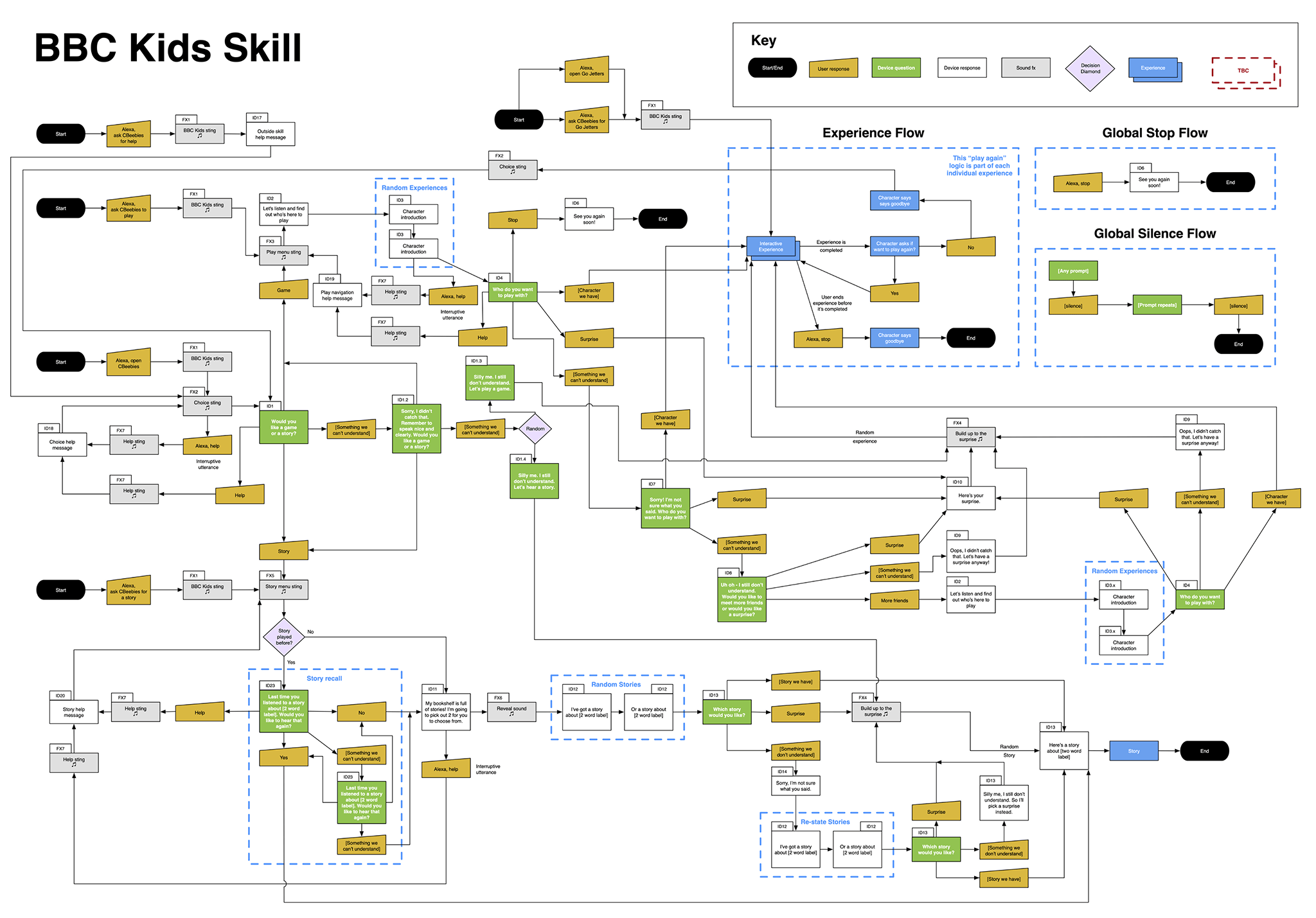
To bridge that gap, we began prototyping experiences as recorded audio demos instead. Rather than reading complex flow diagrams, stakeholders could simply listen to the interaction as though it were a finished product.
I also designed a lightweight visual prototyping tool that paired the audio with simple instant message-style chat bubbles, allowing stakeholders to follow conversations in a much more natural and accessible way.
Prototyping often felt closer to producing a radio play than designing traditional software.
These new approaches significantly improved communication across disciplines and helped the wider team understand the emotional tone, pacing, and personality of the experience far more intuitively than static documentation alone ever could.
Deceptively simple interactions
As development progressed, we realised that many of the BBC Kids Skill’s most important design decisions were effectively invisible to users.
Simple conversational moments often concealed a surprising amount of behavioural thinking, scripting logic, and iteration beneath the surface.
Through continuous usability testing, we observed that children interacted with voice interfaces very differently to adults. They interrupted prompts impulsively, lost concentration quickly, struggled with ambiguous wording, and often changed their minds mid-conversation.
One particularly important moment came when a child became visibly upset after hearing the phrase “Sorry, I didn’t understand what you said.”
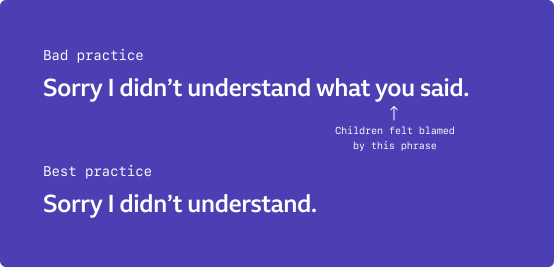
He interpreted the response as a personal failure rather than a limitation of the technology.
That single moment fundamentally changed how we approached conversational error handling. From that point onwards, we avoided language that implied blame and instead designed responses that protected the child’s confidence and sense of agency.
Behaviours like these forced us to rethink how conversational interfaces should be structured.
I helped establish a set of interaction principles that shaped the experience throughout development. We simplified prompts into shorter, more distinctive choices with answers that were easier for children to pronounce and for Alexa to distinguish reliably.
And we became extremely deliberate about sentence structure and timing.
Rather than ending prompts with long explanations, we learned to surface choices first and place the actual question immediately before the listening window began. This reduced interruptions, improved recognition rates, and made interactions feel significantly more responsive.
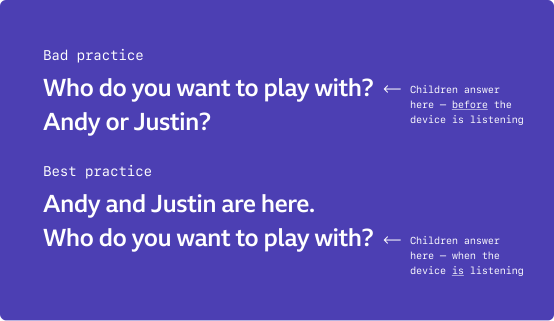
Another important lesson came from observing how parents naturally guide children through decisions.
Parents rarely ask completely open-ended questions like:
“What do you want for breakfast?”
Instead, they narrow choices down to a small number of manageable options.
We adopted the same approach throughout the BBC Kids Skill, limiting choices wherever possible and balancing discovery with simplicity. Rather than overwhelming children with large menus, we surfaced small, curated sets of content that kept the experience moving quickly and maintained engagement.

Children can still ask for any character they like, but this approach balances discovery with speed.
Over time, these seemingly tiny interaction decisions had a huge impact on usability, confidence, and enjoyment.
The experience taught me that designing for children often means designing for the most distracted, emotional, and impatient version of all of us — and that solving for those behaviours can lead to better experiences for everyone.
Leading a multidisciplinary team
Alongside the design challenges, the project required coordinating multiple disciplines spread across different BBC departments, each with their own priorities, workflows, and perspectives.
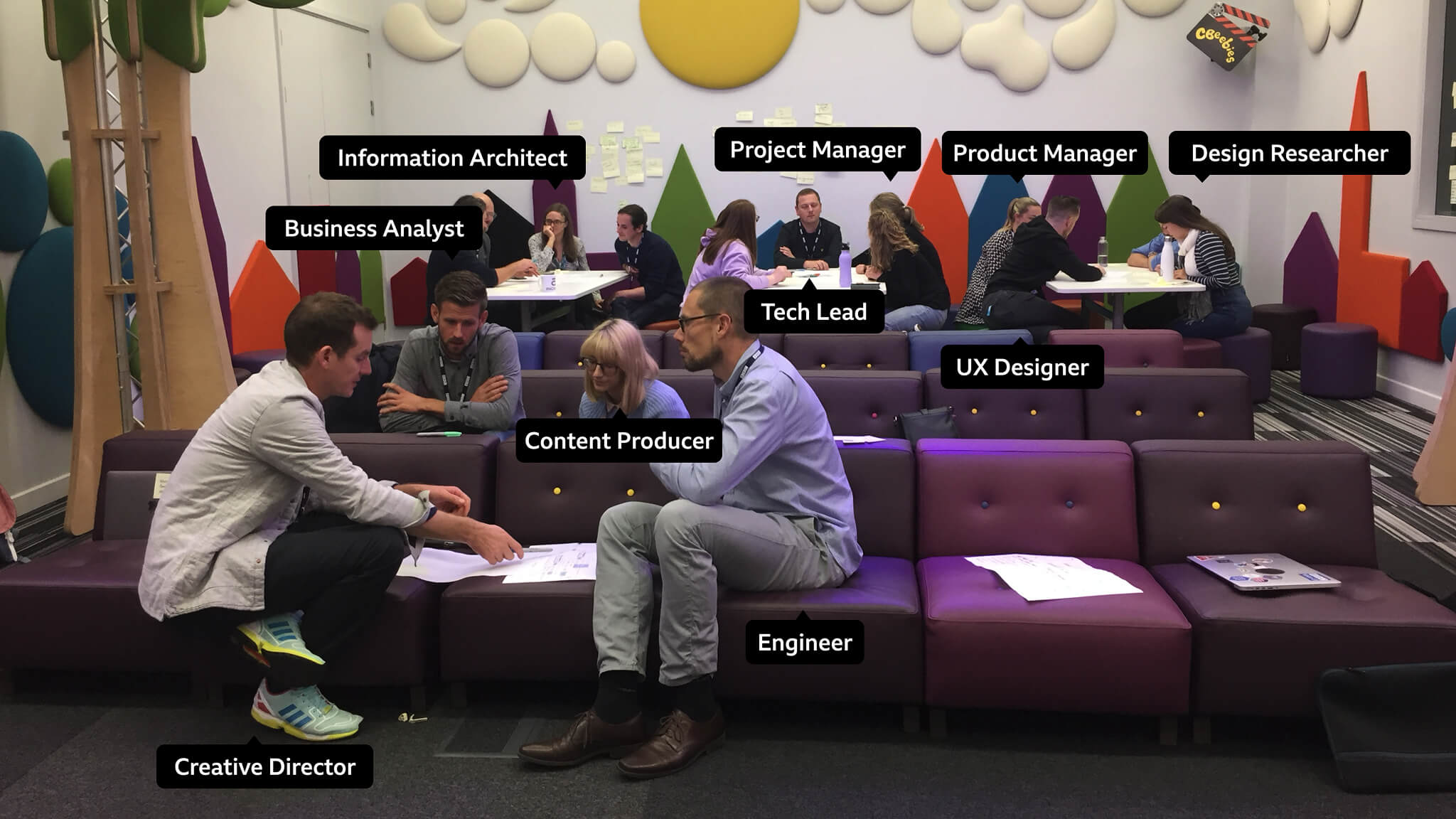
During development, I worked closely with our technical lead Tony to encourage much tighter collaboration between designers, editorial teams, and engineers.
Rather than relying on a traditional “throw it over the fence” workflow, I regularly paired directly with developers myself and encouraged others across the team to do the same.
This significantly improved communication, accelerated decision-making, and helped create a much stronger shared understanding of both the product and the constraints we were working within.
An acclaimed voice experience
The BBC Kids Skill launched on Amazon Alexa in the UK on 3rd September 2018 following seven months of development and nine rounds of user testing.
The response was extraordinary.
The skill delivered record-breaking engagement figures for the platform and became one of the BBC’s most celebrated voice products.
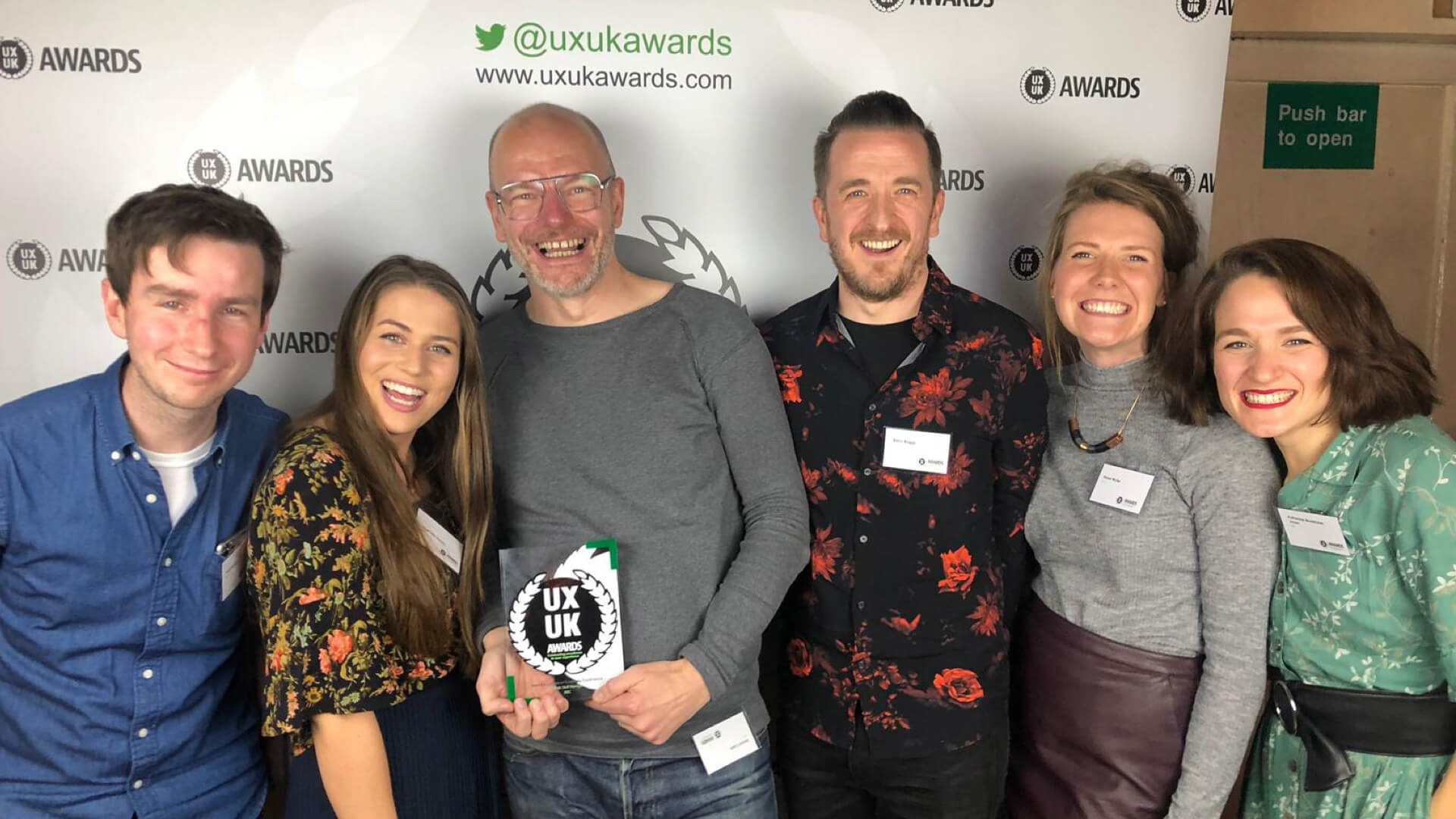
It also received significant industry recognition, winning multiple international awards including:
🏆 The Webby AwardsBest User Experience in Voice
🏆 UXUK Awards Best Education or Learning Experience
🏆 Voice Summit Awards Best Educational Experience
It was a testament to the power of collaboration and the importance of creating safe spaces for feedback and iteration.
Sharing our learnings
Following the launch, I was invited to speak internationally about designing voice experiences for children and conversational UX more broadly, including talks at:
🇺🇸 Voice Summit New Jersey, USA
🇺🇸 SuperBot San Francisco, USA
🇩🇰 LEGO Innovation House Billund, Denmark
🇬🇧 University of Greenwich London, UK
I also appeared on the VUX World podcast (listen to the episode ↗) to discuss voice design best practice and the lessons we’d learned from the project.
After launch, I brought together insights from our research, analytics, and team retrospectives to define a shared set of voice design principles.
I authored and published the BBC’s 12 Design Principles for Voice Experiences ↗ documenting the team’s learning and helping establish best practice for conversational design across the industry.
One of the project’s biggest lessons was that when you learn how to design a voice experience for children, you often learn how to design a better voice experience for everyone.